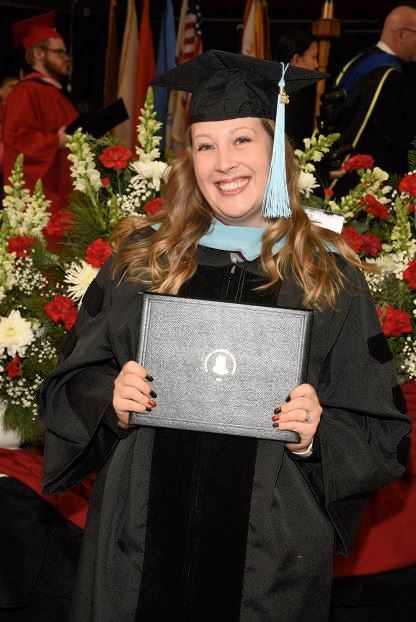
While I’m far from finished with my learning days, I’m officially done with school. I completed my terminal degree in higher education, a doctorate focused on community college leadership, from Northern Illinois University.
You can download my dissertation from NIU’s website. Their Huskie Commons library is a repository of all the research students have completed. It’s mind-blowing to think about all the knowledge contained on a single website from an institution. It’s an honor to be among their masses.
While my profession at a community college centers on public relations and marketing, I delved into a different subject for my dissertation: pedagogy, a scholarly term that describes how teachers teach, better known as the art of teaching. Instructors can be taught how to teach, as K-12 teachers are required to do for their teaching license. Instructors also develop their craft while practicing it in the classroom, as most college instructors do.
Did you know college instructors are not required to have a teaching credential? They have established expertise in a subject (and likely earned a terminal degree in the process); therefore, they are qualified to share their knowledge with college students by teaching a subject. Yet most receive little more than an orientation to an institution. Good college instructors seek pedagogical training, but many are too busy to prioritize it. They learn on the job, through practice.
As I reflect on my college experiences, I recognize my ability to achieve is due to the top-notch instructors who demonstrate a strong commitment to my scholarly success. They instilled in me a confidence that will never fade. I hope we all enjoy the experience of having at least one teacher who connects with you, becomes your mentor, and invests in you through demonstrated actions and conversations in and out of the classroom. Someone we “click” with. An instructor who creates a safe sphere where you can ask any question in the spirit of learning and know they’re going to respond with expertise and compassion.
This experience can be life-changing for scholarly pursuits. Stellar faculty, such as my undergrad mentor, Mike Conklin, and my dissertation chair, Dr. Gudrun Nyunt, gave me the confidence I needed to persist in my studies and make the most of it by applying what I learned in the real world. Combined with classmates who care, my success would not have been possible without all these people in my life.
When I needed to pick a dissertation topic, I became fascinated with the idea that something magical happens when professors exchange scholarly knowledge with students who bring their own practitioner experiences to the table. I’m not saying it’s easy to earn a doctorate degree, but at this level of learning in my mid-career, I already had so much existing knowledge on the subject. I’ve worked in higher ed for nearly 14 years! This program taught me how to apply that knowledge to different discussions, build collaborative leadership skills and critically examine decisions. Faculty aren’t there to see me fail. They’re there to help me succeed and become a bigger thinker. This realization sparked an interest in pedagogy that has yet to fade.
The principle of my dissertation is to be a paper of practice and reflection. My Chapter 3 is a scholarly reflection and I know not many people are going to make it that deep into my research paper. The rest of this blog post is that excerpt and I hope you’ll read it and reflect on where you are in your educational journey and how you got there. — Dr. Lindsey Nemcek
CHAPTER 3
SCHOLARLY REFLECTION
The doctorate is only partly an act of the mind. It is an act of the spirit and the discipline
of a person who was willing to stick with a difficult task, meet multiple evaluations, and
get something done. — Lee Shulman (CPED, 2019)
Introduction
Pursuing a doctorate degree was my natural progression, despite that no one in my family has a graduate degree, or even a bachelor’s degree. My father recently retired from a successful career working his way up from meter reader to reliability engineer at the electric company, a bottom to the top progression without a college degree no one sees anymore. When I was growing up, my mother earned her associate’s degree in applied science at our local community college. I remember holding a newspaper print class catalog and lining up with her to register for classes. As I reflect on it, I don’t remember if I was expected to go to college when I was a kid. It wasn’t until high school when I enrolled in advanced classes that I discovered my potential academic path. College was clearly on the horizon.
Humble to admit, the only doctors I knew were medical ones. My high school principal had a doctor title in front of his name, but I only considered that he must have worked at a hospital before. I’ll always be grateful that my mom had me apply for a collegiate scholars program at the University of Chicago my first year of high school, thanks to a newspaper story she clipped. I started taking college-level classes with mathematicians, philosophers, anthropologists, and archeologists – they were all called doctor. I understood these folks were experts in their fields and they had completed many years of college education to be at a point where they taught the next generation of thinkers. And that was me.
I became a thinker. The University of Chicago taught me to respect academia and inspired me to consider ways I could contribute to the collective body of knowledge humanity amassed. I graduated high school at the top of my class and went on to earn undergraduate and graduate degrees from DePaul University, where I developed a purpose to serve my community through the Vincentian mission. This drove me to the role I am in today at my local community college. And it is that passion for knowing all I can about how to serve two-year colleges that I enrolled in this doctorate program. I specifically wanted to be a part of a community college leadership program, and there aren’t many out there, as accounted for in my study. After interviewing colleagues who completed their doctorate degrees, reading articles, and reviewing program websites, I considered several EdD and PhD programs, ultimately choosing to attend Northern Illinois University after researching CCLPs. The applied EdD was the perfect degree for me, as someone who wanted to continue working and practicing my craft. This cross between coursework and real work created a beneficial intersection that I thrived in. This program helped me reflect deeply on my nature of thinking in higher education.
Reflecting on My Dissertation Research
Throughout my educational journey, I’ve always believed that I am responsible for my own learning. I’ve thrived in the classroom, eager to engage with big ideas that challenge my thinking and make me a more critical consumer of information. I do the readings, take notes, raise my hand; my academic journey has been a very personal, inward-focused process. But in all that time spent reflecting on how I learn, I haven’t spent enough time considering how faculty teach.
I was surprised to find a class on pedagogical innovations and student learning in a leadership program. I didn’t expect that course with Dr. Kari Schimmel to fundamentally change how I think about teaching and learning. My academic approach has always been self-focused, leading me to ask questions like: Who are the students here for? and How can I best learn in this environment? In short, I used to think only of my ability as a learner and not enough about the ability of the teacher. As our class delved into the critical texts of bell hooks, Paulo Freire, and John Dewey, I began asking about intellectual progress from a new perspective: Do students learn as much as teachers think they do? This valuable process of reflection, combined with my coursework on research epistemology and a deepening commitment to the academic community, led me to embrace the idea of studying how faculty teach. I now recognize that student success comes from a powerful combination of effective pedagogy, learner commitment, and the ability to apply knowledge.
My decision to research faculty pedagogy was driven by a desire to expand my scholarly abilities and competence in a new field. I’m glad I chose a topic that has not only sustained my interest for the past year but also provides a foundation for meaningful conversations with anyone. Whether I’m meeting new colleagues or chatting with parents at my child’s school, I can confidently ask about how they learn best or what a favorite teacher did to help them. These questions often lead to an array of answers, and I’ve savored this year of talking about teaching and learning. My passion for these topics is what fueled my research, making it a personally meaningful endeavor that feels as vital and enduring as the act of teaching itself. Ultimately, this research became more than a demonstration of my scholarly ability. It became a rewarding exploration of the very process of teaching and learning that has shaped my own life and career.
In my professional experience as a public relations storyteller soliciting interviews and volunteers, offering financial compensation to participants consistently yields a more robust response rate. I’m very grateful for the scholarship I was awarded from the Illinois Council for Community College Administrators. And while I was initially most excited about having funds to provide compensation for my participants, I became most proud that an organization thinks my research topic is worth funding. This scholarship announcement came at the exact time when I was wondering if this research was worth doing, something all doctoral students might go through at some point in their studies. Having a professional organization deem my research worthy gave me the confidence to keep going. It also provided me a unique platform to present my research findings and a timeline to abide by. I plan to present my findings at their annual conference this fall, part of my duties as a scholarship recipient.
Conducting the interviews for this study was a genuinely joyful experience. I found myself in the nostalgic position of a student, sitting in the participant’s classroom, and observing their teaching. However, these interviews went far beyond a simple lesson. We moved into deeper discussions, reflecting on their journeys as instructors, the teaching principles they value, and their ultimate goals for students. The stories I collected were more substantive than any profile I’ve written professionally, offering nuanced insights into each participant’s individual pedagogy.
This study highlights several teaching techniques faculty should be aware of and employ to teach in EdD programs. With intentional design, my research created room for participants to reflect on their teaching, a core principle in developing best practices (Zeichner & Liston, 2013). Reflective teaching is an evidence-informed practice that supports the idea that learning never stops (Pollard, 2005). Participants in this research individually reflected on their teaching and how they contribute to the professional development of educational leaders who can draw on research, theory, and critical thinking skills to solve impactful problems of practice (Rueda et al., 2013). Pausing to reflect on the way faculty teach and why they practice that way is a worthy endeavor, especially as teaching is cyclical, presenting faculty with opportunities to learn each semester.
When asked how they reflect on their teaching, participants often responded with an inquisitive smile, considering how they review student surveys (occasionally “with a glass of wine”) solicit real-time feedback, and critique their own practice. I witnessed goodness when many participants humbled themselves, critically considering how engaged their students were with the material, what didn’t go to plan, while also appreciating new ideas and excerpts students shared that they could add to their teaching repertoire. Several participants acknowledged reflection is critical to considering course improvements instead of running on autopilot every semester. The exercise of self-reflection caught a few participants off guard during the interview and became one of the most positive parts of the discussion. It is a practice worth pausing for more frequently and I will certainly apply it to my future endeavors.
If I could change something in my study, I would have configured it to explore the dynamics of teaching and learning through a reciprocal interview methodology, where faculty and students interview each other. This approach moves beyond traditional, one-sided data collection to capture a more holistic and nuanced understanding of pedagogical practices. By having faculty and students inquire into the other’s perspectives on teaching and learning, researchers could study lived expectations, effective practices, and reveal the co-constructed nature of the educational experience. This reciprocal method would not only generate rich, collaborative data but could also serve as a professional development tool, fostering empathy and deeper understanding between faculty and students.
Scholarly Practitioner Paradigm: Finding My Scholarly Voice
Scholarship informs practice just as teaching facilitates learning. In pursuit of a scholarly practitioner identity during data collection, I started to consider how dynamic this paradigm is. This process centers on building a new paradigm of reality and developing a greater understanding of scholarly practitioner identity. Through this research process, I have considered where my evolving identity sits in this paradigm. An artist at heart, I visualize the scholarly practitioner paradigm as a vibrancy spectrum where I might find myself consciously bearing witness to a different hue each day. When I’m deep in data gathering and evaluating content for a community impact report, I feel super scholarly, my aura a deep royal blue. My mind is saturated with critical questions, seeking assurance that I’m translating analytical information into something my audience can learn and make decisions from. Other days, my aura shifts into a warm scarlet red when I get to interview students about the free laptop they’ve picked up from a tech donor, tapping into the practitioner part of my brain. My job is to gracefully get people talking about the barriers they’ve overcome in their community college experience and rephrase it into an influential story that creates a sense of belonging others can imagine. On my best days, both colors blend into a vibrant royal indigo, the best of both worlds – a scholarly practitioner. There is beauty in the spectrum of the in between.
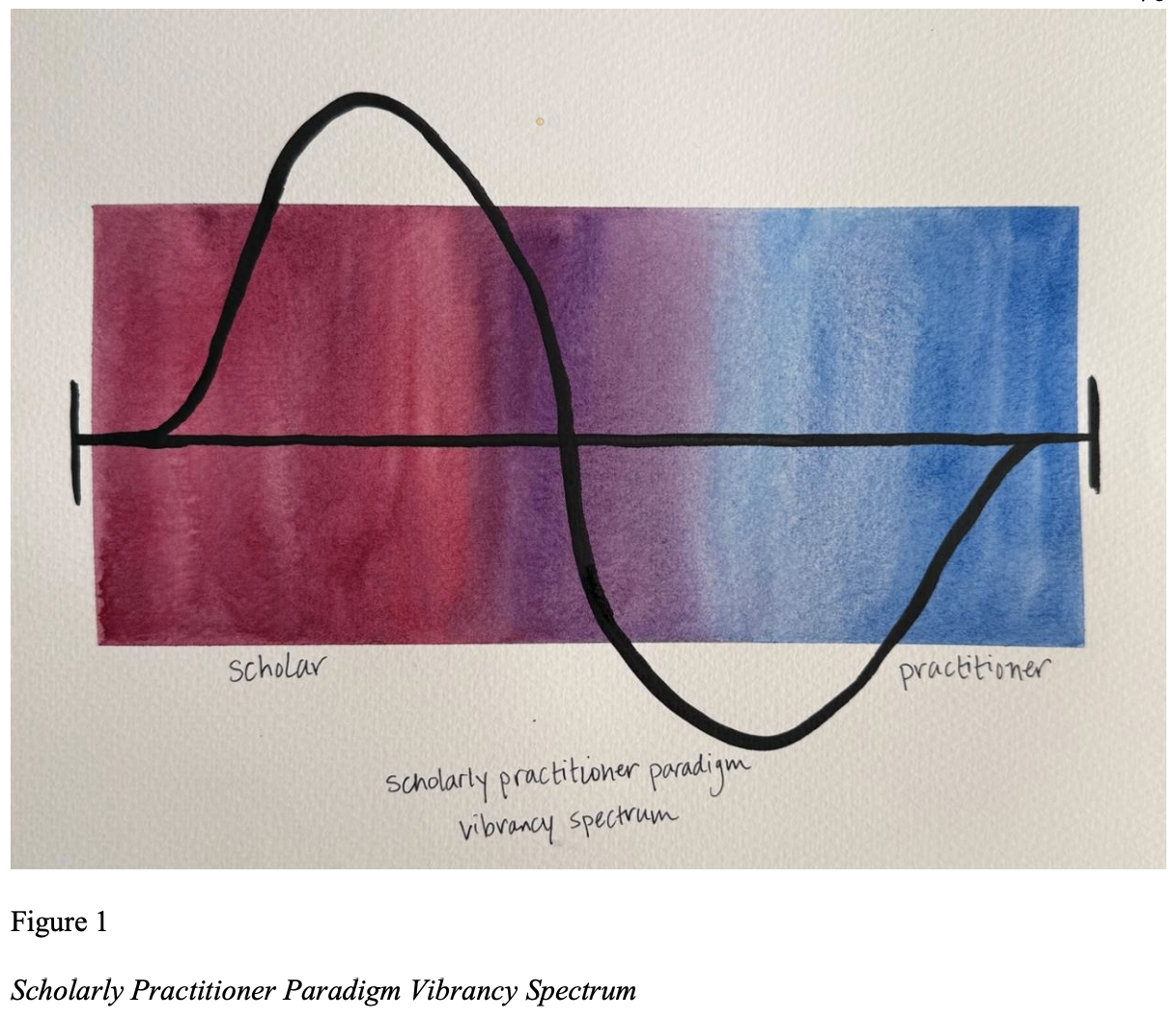
Over the course of this program, I’ve honed my scholarly voice. The last three years were a continuous process of transforming my personal practitioner tone, with every discussion, presentation, and paper serving as a chance to write and speak with more authority. I developed this voice by listening to instructions, embracing a learning curve, and trusting in my faculty and fellow students to give me honest and open feedback. As a public relations professional, my chair’s guidance was essential in helping me shift to a scholarly mindset. They ensured my research was grounded in reliable data and not biased or over-interpreted by my marketing background. This transition was one of the most challenging, yet rewarding, parts of my doctoral journey. The iterative process of writing my dissertation has given me plenty of practice. This scholarly voice is now a unique asset in my professional life, demonstrating a new capacity for leadership and critical thinking. I am proud that this research is an authentic reflection of my growth.
Despite not being a question in my interview protocol, most discussions with my participants touched on where they see themselves in this paradigm. Are they more scholarly or practitioner-based? They reflected with me on how this is a subjective observation. It was easier for participants to consider where their fellow faculty might sit on the spectrum, but harder to self-reflect where they are. I think that’s because, internally, we have an evolving identity that blurs beautifully between the two. As I conducted my data analysis, I found myself wanting to ask my participants more questions about this paradigm. I could do an entire study on this topic, perhaps one day in the future. One of the CPED framework outcomes of the EdD is to embrace the identity of a scholarly practitioner, someone who can advance the professional practice. Perhaps an indication of my scholarly practitioner identity, I continue to ask: what is the role of professional wisdom in academic inquiry?
Contributing to a Community of Practice
When I started researching potential guiding frameworks for my dissertation, I became fond of Wenger’s Community of Practice (CoP), a commonly used social learning theory in educational research that posits social relations influence one’s ability to learn (Farnsworth et al., 2016). Ultimately, I chose not to use this framework, as its design is more student-centered and my research focused on faculty. Aligned with my experiences and beliefs, learning is identified as an activity of legitimate peripheral participation among a community of practitioners (Lave & Wenger, 1991). Wenger conceptualizes CoP not necessarily as a group of people or a team, but broadly defined collaborative spaces where individuals engage in shared learning and knowledge exchange that influences action (Colburn & Stein, 2006). It is the “social process of negotiating competence in a domain over time” (Farnsworth et al., 2016, p. 143) in contrast to many traditional learning theories where the individual is responsible for their own knowledge growth.
The notion of CoP cannot be applied to just any group and is distinctively different from functional teams working on a joint task (Farnsworth et al., 2016). Aligned with the cohort-based learning models of many CCLPs, there are three definitive characteristics of CoPs including joint domain of interest, shared repertoire and mutual engagement (Wenger, 1998). In these communities, members engage in joint activities and discussions, helping each other by sharing information. These build relationships established in mutual engagement I recognize as similar to a group of scholarly practitioners sharing experiential learning lessons. Distinctively relevant to this research study, CoPs are not merely a community of interest; they are practitioners that experience a shared repertoire of resources, including experiences, stories, and tools. Essentially, they have a shared practice.
Before I began my doctorate degree, my academic journey was often directed at being the best. While I am intrinsically motivated to learn, the extrinsic motivator of grade performance never hurt. I wanted that perfect score, to graduate top of my class, to graduate faster than everyone else. Once I joined this cohort, I felt myself settle into pace besides a family of learners. It is this community of practice that I’ve learned so much from. It’s being in a cohort with budding scholarly practitioners where I’ve learned about the different facets of their functions at community colleges, as counselors, instructors, admissions directors, researchers, advisers, and registrars. By the luck of the draw, my cohort is composed entirely of women. They are mothers, aunts, sisters, neighbors, and friends. These are the people I learned with and more importantly from. I feel strongly it is this community of practice that I gained the most benefit from in my doctoral degree. While the instructors in our CCLP are certainly knowledgeable and experienced at researching and teaching, many of them do not have the same experiences working at community colleges. They have theoretical knowledge of our institutions, but they lack the practical understanding we, as practitioners, have. Together, with our faculty, we learn through collaboration.
As someone with experience belonging to a CoP as a primarily online doctoral student, I can identify that my learning extends beyond the readings, lectures and assignments of my CCLP’s curriculum. The richness of the scholarly practitioner identity I developed was through meaningful relationship building. Learning happens when we least expect it. As I reflect on my program, my ah-ha moments appeared during office hour conversations with faculty and GroupMe chats with classmates who became colleagues. We have built an informal network bound by shared experience and passion for a joint enterprise: community colleges. The learning I have ahead of me feels boundless and I benefit from association with colleagues across the country who serve community colleges. Since many of my fellow candidates have already defended their dissertations, I know our CoP will continue to evolve as we take on our next chapter in life.
Onto the Next Chapter
At the beginning of my doctoral journey, Dr. Quortne Hutchings offered sage advice: “This program doesn’t define you; it reveals who you really are.” My learning in this program happened at a much deeper level than at any other stage of my life as a student. My wisdom and clarity have shifted to uncover the nuance and dimension of teaching doctoral students who are community college practitioners. This degree program prepared me for the next chapter as I continue my journey as a community college professional, supplied with a strong scholarly practitioner voice, a reliable community practice, and a strengthened respect for all colleagues who teach students.
###
 The Glory of Life as a Suburban Wife